Gamers In Time
A 1 v 1 PVP Card Strategic Board Game

How it Started
The First thing I did was to Analyze the market, who could our competitors be, and who would the game be? so we started digging...
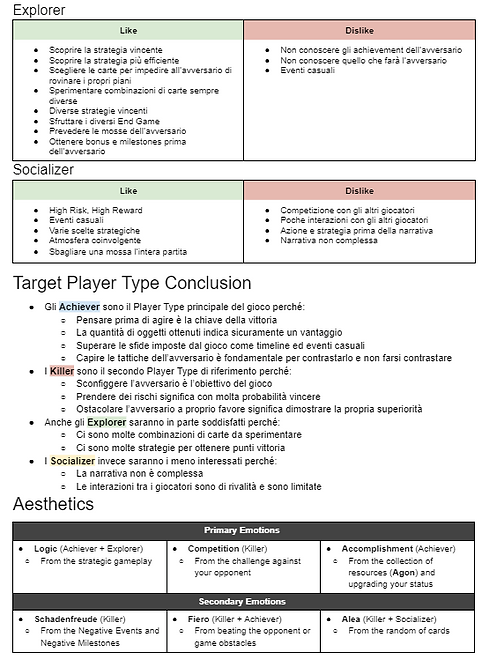
...Even if I analyzed all the competitors and player archetypes, our lecturer, Diego Ricchiuti, told us to Aim for Achiever and Killer to fill all the possibilities.
So the team decided to Aim at two principal types, Achiever and Killer, ignoring the other two and upgrading what we could offer these players.


And more...
Researching History
Once researched the board, Player Base, and Archetype we started to think how which videogame era represents it, we decided that the videogame era was the very first one
From 1973, with the debut of Pong and Atari to 1983, when the videogame industry crashed.

But how could we use this IP without having legal issues? the first answer was to do a parody. of So we searched what existed in the timeline we decided to settle the game.
Then With Valerio under his knowledge, we woked differenton Concepts of the Story.
Components
Mechanics and
Balancing
The Components and the User comfortability were a challenge that we know we should have faced.
With the Base of the game to cover the first 10 years of the history of the videogame industry, we know that a lot of cards would be developed and we needed to think about how player would manage their resources.
So we designed everything to be reachable by the hands of the two players, containers to put resources like Money, Hardware, and Workers.
The Player board is where they can place their cards.

Cards and Resources can be obtained differently, the most common thing is to place the action token, which comes in black and orange, that needs to be placed in different sections of the board.

Project Card
These cards contain games and a console, and give you Reputation Point, Resource, and Sometime Bonus Cards.
-Emotions-
Informative
Alea
Challenge
Logic

-
Game Name
-
Real Year of Release
-
Price
-
Developing
-
Rewards
Bonus Card
These cards allow you to activate an effect when you want, this can be a bonus to you or a malus to the player.
-Emotions-
Fiero
Schadenfreude
Agon
Logic
Alea

-
Bonus Name
-
Description


Project Card
This will be given to you at the start of the game or at the beginning of the turn to give you some extra objectives to complete, this will give you different rewards.
-Emotions-
Logic
Fiero
Fiero
Alea

-
Description
-
Reputation Point
Event Card
Every 2 turn, a random event will occur, this active effect will be both for the player and is described in the front of the card, it can be a malus or bonus.
-Emotions-
Alea
Surprise
Challenge
Logic
Fear


Contract Card
This is the main resource income card.
They have the passive effect that every turn you gain some they have also Active Effect once used you need to Discard the card
These Cards introduce the Rarity Concept, as seen in the image there are rainbow tier cards that are very powerful
-Emotions-
Expression/Creativity
Accomplishment
Logic
Agon

-
Contract Name
-
Resource Gaining
-
Active Effect
Of Course, I had my share of problems while balancing the game, in particular, there was this mechanic called "sanction" that was planned to be a high-risk reward mechanic you could pay less or don't pay at the end of the turn to have more money in the bank, but the tax system would be heavier
But if you would just develop no matter how much sanction you had the advantage and incomes of the cards would fix that problem, it was a case of Dominant Strategy so in the end, we cut the mechanic
I and the team have done Versioning documents to balance the game, since tunning the game was the hardest part, without the proper playtest we wouldn't have found out


These are the versioning docs for the Event, Project Card, and bonus card.
How To Play
Position the Resources on the Board like in the immage

Once the preparation is ready.
The player who most recently played a video game goes first in the opening round. The Starting Player takes the Starting Player Token. It will serve to indicate who will place the Action Token first. It will Alternate Between the players at the end of the turn, at the start of the turn the players get an amount of resources.

The Action turn begin, the Action Token of the Respective Color needs to be placed in the Desired Zones, with each player a maximum of 7 Action for the turn

Once The Action Turn Ends the Unwinding Turn, this Challenges and Acquirments get Resolved and the Players get the wanted resource, depending on which resource they were trying to acquire they will need to pay in different ways


Ending the turns, players will need to pay taxes for each action they positioned
This Get Repeated until the end, at the end of the game the player with most reputation point win
If you want to know more in detail read the rules in detail here.
Production Cost And Final Pitch
We pitched the game 3 times, once for the approve of the game, the second time for the teacher to test and the final time for the production and market cost of the game, were we did different research for the card, token and board cost
For Example, here we have the production cost we did for our cards, we had in mind to do two different versions, a small portable version of the game that was the one we did first since we designed the board to match the table of the academy to make the game comfortable for them and our colleagues, and then an analysis about our competitors and how much they were selling their games


And For the Final Pitch, we had in mind to show an example of the illustration that would be in the game
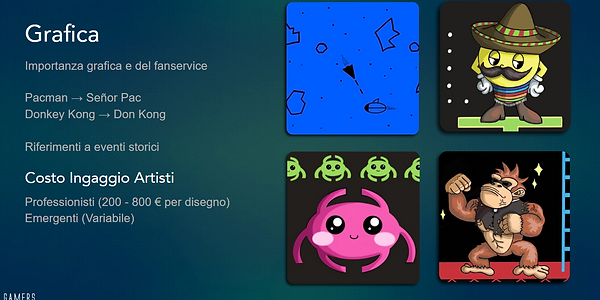
This was done in collaboration with Erica Panettieri, an artist in the sector who decided to work with us, we would give the basic concept, access to our drive to help her understand what we wanted and we were really happy with the result
Moodboards and Production
The Pitch was a Success, we won the yearly contest at A.I.V and made our games to be enjoyed to different Italian events, AIV with Ignition decided to help us publish the game, and they would take responsibility for the production


We Decided to Help with the illustration and Mooboards, the objective was to recall the mad magazine style for the developers and to go for a stylized parody style for game characters following the aesthetic of the 70s,80s, and 90s